





























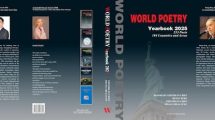









Main Themes of the Book
- 1. Poetry as a bridge – the poet as a guardian of identity
Many poets in the anthology explore the question, “Who is the poet?” and see poetry as their true home, particularly in situations of exile or wandering. A few examples:
Jeton Kelmendi (Albania-Belgium) writes that poets have no home other than their poems, living between the traces of time and dreams.
Iris Calif (Israel) is described as taking on a “divine calling,” using poetry as a tool to convey messages of life and healing.
- 2. Shared themes among diverse creators – loss, memory, and exile
The theme of displacement and the search for belonging recurs among many poets, whether referring to physical or spiritual exile:
Angela Kosta (Albania-Italy) writes about memories of homeland and the search for belonging through language. Tasneem Hossain (Bangladesh) expresses the longing of an immigrant for her native land, where memories are kept in her heart like a treasure chest.
.3Existential anxiety amid nature and the modern world
Many poems reflect on the fragility of the world, both ecologically and politically: Liang Xiaoming (China) describes darkness descending upon the world and the heart- a sense of time passing and leaving humans alone.
Tang Shi (China), in “The Flowers Sleeping While Holding Dewdrops,” listens to the voice of a flower opening; this simple act transforms the entire space.
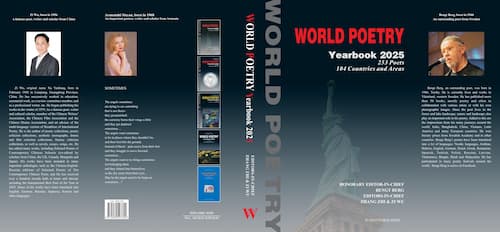
The editor-in-chief of the yearbook is the Chinese poet Zhang Zhi
The anthology is led by the Chinese poet Zhang Zhi, who serves as chief editor. In his poem, he presents the underlying philosophy of the anthology: a cosmic vision of unity. Zhang writes about the merging of the self with the universe. The poet as a modern prophet uses images of galaxies, stars, light, and oceans to show that all humans share the same dome- poetry becomes their “first language”, a celestial language- a kingdom of poetry. This is the globalization of poetry: a language that connects hearts across boundaries.
We witness a spiritual process in which the “village” transforms into a kaleidoscope of light- a sublime space, almost a temple, where poets exchange rays of inspiration. Zhang emerges as a spiritual leader, guiding all the poets in the anthology.
The Cosmic Frequency of the Anthology:
Zhang Zhi’s anthology is not just a collection of poems but a manifesto of humanist globalization. While the modern world can seem mechanical and alienating, his approach envisions globalization as a living neural network, with each poem resonating across the world. This echoes the concept of the “cosmic birthday” in Agron Shele’s poem, symbolizing the rebirth of the self as a microcosm of the universe. Placing Shele at the beginning of the anthology is a deliberate spiritual statement: poetry is a bridge connecting nations, bringing the individual into universal consciousness. Poetry is the “spiritual glue” allowing poets from different cultures to celebrate shared existence. This is truly the importance of editor Zhang as the conductor of the entire orchestra:
- The editor as a “crossroad” of cultures
In the poem, Zhang describes a constant movement of ideas and images that cross borders. As an editor, he applies this by selecting poets from different countries (such as Agron Shele), creating a “conversation” between them within the pages of the book. His poem testifies to a leadership that is not centralized, but rather one that allows each voice to maintain its uniqueness within a shared space.
- An ethic of compassion and global responsibility
Zhang expresses the concept that the suffering of one individual is the suffering of all humanity. His leadership as an editor is reflected in his choice of poems that do not merely focus on the narrow “self”, but rather those that echo grand moral questions. Under his baton, the anthology becomes a tool for Tikkun Olam (repairing the world) through the written word, as reflected in the lines of his poem which deals with a soul-connection that transcends the material.
- Poetry as an “alternative language” to globalization
While the economic world utilizes globalization to homogenize cultures, Zhang the editor uses his poem to propose a “globalization of depth”. He leads an editorial line that seeks a common spirit. His poem serves as the “key”- instructing the reader not to search for the differences between the poets, but rather for the common cosmic “frequency” they share.
The main motto of Zhang Zhi is “Globalization of Poetry”. This is a spiritual process in which “the village” becomes a place where poets exchange rays of light. It is the eternity of poetry’s glow that triumphs over all. This global frequency is indeed present at the very opening of the book.
The diversity of the writers testifies to an openness- together, they create the anthology’s balance. This insight touches the very heart of the collection. The poem by Sabyasachi Nazrul from Bangladesh, titled “World One Village One,” serves as a sort of manifesto for that same “unified humanity”. There is a spiritual connection that overcomes political borders; we are all residents of the same physical and spiritual home.
The Poet Taghrid Bou Merhi (Lebanon-Brazil) connects the motif of creation with the spirituality that unites humanity. According to her poem, a woman is a harmonious divine creation, a “melody of serenity”. The poet uses the motif of creation to describe her essence: the biblical description of the “rib” is elevated—in her poem, the woman is created from spiritual raw materials. She was not formed from simple physical matter but was shaped by the Creator. Her figure possesses an almost magical power- when she is sorrowful or embittered, gardens wither; but when she smiles, there is light and “blossoming meanings”.
The poem concludes with a magnificent image: “She is the woman… God’s open book of mercy”. This is the peak of the description- the woman is the most tangible expression of divine mercy in the world.
Different Landscapes – A Gaze into the Spiritual Landscape
Although the poets come from different regions and vastly different landscapes, the landscape holds an existential spiritual meaning for them. For example, the poem by Duan Guang’an from China describes a tree beside a rock; for him, their coexistence expresses an idea that transcends material concerns.
In the poem by Duan Guang’an from China, the image of the tree and the rock is not merely a botanical or geological description, but a spiritual “landscape painting” (akin to the classical Chinese painting tradition), where the scenery serves as a reflection of resilience, partnership, or spiritual stability. The anthology is teeming with poets who use “landscape” as a mirror to reveal human existence. Here are several prominent examples of this connection between nature and the spiritual existence:
Arslan Bayir (Turkey)- his presence in the anthology adds a layer of emotional power and a deep connection to the landscape and simple humanity, as part of the Mediterranean and Central Asian mosaic. As a poet, he represents poetry as a bridge between nature and culture- these are the hues he emphasizes. His is a poetry of landscapes and memory. Bayir writes from a deep affinity for the earth and the open space. In his poetry, one can sense the scents and colors of the Turkish landscape, yet they serve as a backdrop for broader existential questions. He transforms physical geography into a geography of the soul.
For the poet Mariela Cordero as well, geography is a metaphor for the human spirit. The “cruel tide” of the sea is an allegory for the inner self: the poem describes a moment of crisis where the tide becomes so “cruel” that it threatens drowning. The central and comforting idea in the poem is that suffering and hardship (the “cruel tide”) are not intended to drown the individual, but rather “to prepare them for the depths of another ocean”.
In the poem titled “LONGING…” by the poet Hassane Yarti, we are moved by a profound lyrical work that explores the creative process born out of pain and solitude. The writing is not done with ordinary ink, but with an “alphabet of tears”. This is a powerful image of the inseparable bond between personal suffering and artistic expression.
Also in the poem by Muhammad Gaddafi Masoud, nature and autumn also serve as metaphors for the human spirit. Gaddafi uses a beautiful yet painful image where anxiety “grows flowers of insomnia”. Anxiety is not merely a negative emotion; it is a living thing that grows within a person and robs them of their rest. Helplessness in the storm: the poet describes a feeling of complete helplessness within the “storm”, probably the turmoil of his emotions.
Bengt Berg (Sweden)- expresses a landscape of contemplation and silence- writing from the Scandinavian landscape. For him, the snow, the forest, and the open spaces are not merely scenery but express a human state of listening to silence, a space for internal soul-searching. There are European poems whose landscapes reveal specifically human fragility in the face of the ravages of time and history. In the poem of Maria Miraglia from Italy- the sea is an image of a soul that knows no boundaries. Similarly, among Latin American poets in the collection, the earth is a living entity that converses with man, and the landscape reveals a humanity that is not separated from nature but rather melts into it.
The poem by Yehudit Malik-Shiran describes the woman as a province of hope; there is something in her stronger than the landscape. Hope allows a person not to leave even “through all the storms”. One of the most powerful images in the poem appears in the “Bridge”: “The cracks are what shine the light inward”- the cracks they shine the light in.
The landscapes in the poets’ poems take on shades of personification and spirituality: the anthology shows that despite the differences in scenery- the Chinese rock, the Swedish snow, or the Italian sea- the human action is identical: the man projects his deepest emotions onto the landscape in order to understand himself. The landscape is the “language” through which the poet explains what it means to be human- whether it is to be stable as a rock, flowing like a river, or passing like a cloud.
Echoes of this approach can be found in other poets in the anthology who celebrate the landscape: Xi Ke (China) paints an emotional picture. The poet focuses on fleeting moments of light and shadow, sharing the perception that life is found in the small details.
Iris Calif skillfully writes about light as an element that transforms existence. In her poetry, light is not only physical but spiritual—it is what tints pain with hope. Similar to Eduardo’s mountain that changes the picture, the light in Iris’s work is the factor that enables healing and internal change. For the Mexican poet, the existential common denominator: these poems, along with Eduardo’s poem, express the idea that the man is not separated from his environment. The landscape is not just “outside of us”; it is a spiritual event occurring within us.
It seems that poets from all over the world agree on one thing: when we observe the landscape deeply, we are actually observing ourselves. Poetry knows how to express the changes occurring not only in the landscapes- but also in us.
The ability to survive the changes
In this anthology, the aspiration to understand the shifting universe and adapt to life’s transformations (resilience) is a recurring motif among other poets, who offer different ways of coping with the “existential journey”: the poet Jeton Kelmendi (Albania/Belgium)- writes about the man as a constant wanderer. For him, adaptation is not just physical survival but the ability to carry one’s home (memory and language) within the heart while the external landscape changes.
Luis Benítez (Argentina)- observes change through a wider lens. For him, the existential journey is part of a long human chain. The aspiration to understand the meaning of change is an attempt to decipher the “code” of existence. His partnership with Costa lies in the understanding that change is not the enemy, but the essence of life itself.
Changes over the years are the factors that cause crisis in marital life. This is a poem by Alexey Evgenievich Kalakutin– the Russian poet- who gives this profound expression: The poem presents a sharp contrast between the ideal dream of a relationship and the challenging reality. This dream shatters into what is described as a “stormy battlefield”. The contrast is emphasized by the image of an attempt to light hundreds of lamps in a hall, while in practice, only a “dim light flickers in the closet”.
Jiang Yimao also chooses to describe a crisis. Yimao’s poem creates a moment of exposed confession. His explicit request at the end- “Father, forgive my lying words to comfort you”- is the beating heart of the work. This is a “falsehood” of grace, a son’s desperate attempt to protect his father from the knowledge of his approaching death, making his sense of guilt particularly heart-wrenching for the reader.
If in Yimao’s work we saw the attempt to preserve humanity within personal moments of parting, Natalie Bisso expands the gaze toward human morality in a violent and complex world. Here are a few points for reflection on her poem “Stay Human”: Bisso argues that being born human is a miracle, but remaining human is hard work (“To remain a human being is work!”). This is a central message in an international poetry yearbook- poetry as a tool for preserving the human image. She emphasizes freedom of choice (“everyone is free to choose their own path”) and the need to remain faithful to sacred values.
The poet Dibran Fylli impresses in his poem, “Shadow of Hope.” The poem deals with the complexity of human memory and the struggle to maintain hope within a reality of pain and intense changes. Dibran uses the metaphor of the shadow not as something threatening, but as a guiding presence that testifies to the existence of light- even if the light itself is currently hidden.
The poem by Mujë Buçpapaj from Albania, “The Invisible Victory”, is a concise work dealing with the tension between fleeting human existence and the moral act. The poem opens with images of nature and solitude (“field of solitude”, “ripe corn”), hinting at the cycles of life and growth. The poet describes intimate and elusive moments- a sun setting in a swamp, writing in steam, and a blowing wind- all symbolizing the transience of the moment. We must not forget that time erases physical labor but leaves another residue. Before us is another expression of coping with changes; we must learn to seek the invisible victory. And there are changes that occur and demand an answer to the distances that have formed due to the necessity of reality. Tasneem Hossain (Bangladesh)- this poet writes about the transformations experienced by a person who moves away from their homeland.
The Common Idea: the man is required to be in constant motion. The universal common denominator here is the flexibility of the spirit: the ability to see life’s transformations not as destruction, but as an opportunity for a deeper understanding of existence. This is a very relevant message for today’s “global village”, where changes are rapid and intense. Poetry reminds us that while the existential journey is individual, the aspiration to find meaning within it is common to all.
Arslan Bayir, as one who brings the voice of the simple man, indeed comes to express meaning for existence. There is a measure of modesty and simplicity in his poetry that grants his words the validity of truth. For him, poetry is a way to “comfort” the world- to preserve our humanity: not to forget values, and to illuminate the beauty existing in nature and in the connection between human beings.
The Language of the Heart – The Story of Us
All Poets from around the world seek to give us the universal language of the heart, the story of us all.
Isilda Nunes from Portugal searches along these paths for the inner language of dreams- while for other poets, this is expressed through creative freedom.
This fascinating anthology is a living, breathing story- a microcosm of all humanity. The anthology itself functions as a sort of “family of poets”; just as one generation passes inspiration to the next within a nuclear family, the poets in this anthology inspire one another across national borders. Before us is poetry that reveals a multifaceted human countenance- everything becomes a fascinating and rich life story.
Dynamics of Poetry Observing the Foundations of Existence
Fei Yifei is a poet who is a master of the profound gaze- Fei Yifei brings to the human caravan the power of observing nature. He focuses on small details (such as a tree, a rock, or a stream of water) and transforms them into existential metaphors. It is beautiful to compare this poetry to the work of the prominent Chinese poet Zi Wu, who also serves as the one of the editors-in-chief of World Poetry Yearbook 2025 and is a key figure in the modern Chinese poetry community. There is power in his poem, “A Strange Encounter Beneath the Ancient Banyan”- it is fascinating to read about the tension between the written word, which is static and limited, and the “spirit”- which is the living, changing essence of the human and poetic experience.
Poetry as a Tool for Communication and Expressing Messages
The goal of the anthology is a connection with the readers, with the public- poetry as a tool for human connection (networking of the soul). Here, it is appropriate to emphasize the work of an Israeli poet. Yehoram Galili brings a clear voice that highlights the communication between human beings. His poetry does not seclude itself in an ivory tower but rather turns outward. Galili knows the secrets of connecting with the audience; he understands that the word is a bridge. In his poetry, he seeks dialogue, the encounter between the “I” and the “You”, and the ability of the poem to create a spiritual community. This is a direction of “communicative poetry”- one that seeks to touch, influence, and connect.
Indeed, there is a variety of poems about the power of poetry: there is beauty in the work of the German poet Natalie Bisso. Her poem, “The Silence of the Stones”, deals with the tension between eternal, static nature and fleeting, noisy human existence. Through the motif of stones, the poet places us between ancient memory and stability versus human words, which sometimes lose their meaning.
The tension in poetic expression receives further interpretations: on page 141, the heart is captured by the poem “Earth’s Swan Song” by the poet Dimitris P. Kraniotis. The poet conveys a message: the damage to nature is directly reflected in the soul. The external world and the internal world merge- as nature crumbles, so does the man. When we lose nature, we lose a part of our humanity- our hope, our childhood, and our ability to dream.
About the editor-in-chief and founder of the anthology World Poetry Yearbook
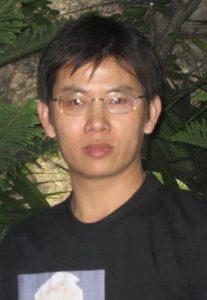
Dr. Zhang Zhi- China
Zhang Zhi, pen name is Diablo, English name is Arthur Zhang, was born in Phoenix Town of Baxian County, Sichuan Province in 1965, is an important poet, critic, translator and publisher in contemporary China. He is a doctor of literature. He is the current editor-in-chief of Rendition of International Poetry Quarterly (multilingual), editor-in-chief of the English edition of World Poetry Yearbook, and advisor to the Center for Globalization of Chinese Poetry of Nankai University. He has published seven collections of poetry in foreign languages, translated eight collections of poetry and a full-length novel. His literary works have been translated into over fifty different foreign languages. He has won literary awards from over thirty countries. He now resides in Chongqing City.
The Anthology as a Front of Hope and Spiritual Unity
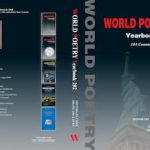
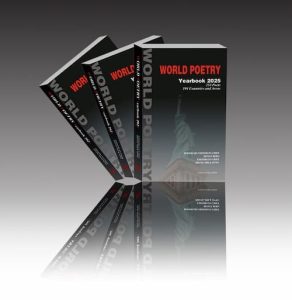
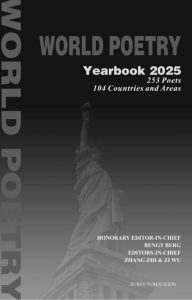
The meeting of 253 poets from 104 countries is an act of struggle against global divisiveness and despair. The anthology does not abandon the belief that the written word can unite the global village. This anthology is much more than a collection of poems- it is a roadmap for human coping with pain, upheaval, loss, and the search for freedom. Above all, many poems deal with identity and transformation.
The poetry of Balfour Hakak from Israel is indeed steeped in the struggle between eternity and time- poetry inextricably linked to existence in the land of the Bible and the land of Israel. The biblical myth continues to throb: the poetry frequently dialogues with figures and events from the Bible, projecting them onto modern Israeli reality and creating a historical and spiritual continuum of thousands of years. Balfour’s poem, “A Small Sanctuary” (Mikdash Me’at), reveals a search for the sacred within the profane. Existence in the land of Israel is a process of spiritual construction.
The yearbook “World Poetry 2025” is proof that beneath all the different languages and landscapes, we all need the spirit of creation- that same aspiration to grow, as we saw in the poem about the tree and the rock. Poetry is the force that ensures that despite the “winters” and upheavals, new growth will always come.
In the vast desert of the 21st century, where the noises of war, hatred, and alienation grow- threatening to destroy the common human denominator- there is hope: there is unity. Here marches the “Caravan of Poets”- 253 creators from 104 countries- like the caravan in the biblical desert, they seek redemption. It is within the power of poets to restore the world’s spiritual conscience. The anthology proves that poetry is not just words on a page, but an existential toolkit for dealing with separation and alienation- and especially with the depths of pain and crises of identity.
The anthology illuminates the spiritual connection; there is hope for the world.
(Translated from Hebrew to English by Yarden Zehavi)
About the editor-in-chief and founder of the anthology World Poetry Yearbook
Dr. Zhang Zhi- China
Zhang Zhi, pen name is Diablo, English name is Arthur Zhang, was born in Phoenix Town of Baxian County, Sichuan Province in 1965, is an important poet, critic, translator and publisher in contemporary China. He is a doctor of literature. He is the current editor-in-chief of Rendition of International Poetry Quarterly (multilingual), editor-in-chief of the English edition of World Poetry Yearbook, and advisor to the Center for Globalization of Chinese Poetry of Nankai University. He has published seven collections of poetry in foreign languages, translated eight collections of poetry and a full-length novel. His literary works have been translated into over fifty different foreign languages. He has won literary awards from over thirty countries. He now resides in Chongqing City.
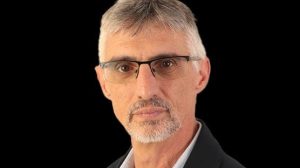
About the author of the article
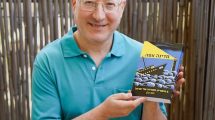
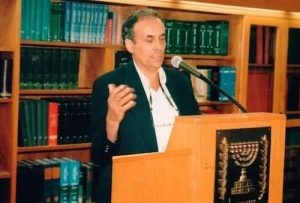
Herzl Hakak, an outstanding writer, poet, and literary critic. He has published articles on various subjects: literature, identity, and Judaism. He served as Chairman of the Hebrew Writers’ Association in Israel from 2003–2005 and again from 2011–2015. He has written 10 poetry books and has also published, together with his twin brother, children’s books, books of literary criticism, commentaries on sacred liturgical poems, and a lexicon of language. Most recently, his poetry book “The Song That Was Never Sung” was published by Shalhevet Jerusalem Publishing House.
Selected Awards Over the Years:
The “Harei Harshon” Prize, awarded by the Hebrew University, for the poetry book “The Book of the Lights of Love”, 1972.
The “Harei Harshon” Prize for Criticism- for the book “Chapters on Berdyczewski” by Herzl and Balfour Hakak, 1974.
The Wallenrod Prize- awarded by the Hebrew Writers’ Association, 1980.
Certificate of Appreciation “Olim u’Magshimim” – Ministry of Education, 2018.
The Uri Orbach Prize for Poetry, awarded by the Department for Jewish Culture – 1 Nisan (2021).
ACG Prize – Citation of Merit for Lifetime Achievement in Poetry – 2025.
From the judges’ statement:
“The poet brothers Herzl and Balfour Hakak have been among the builders of Hebrew national poetry for decades. Together, and each on his own, they crown our culture with a noble Hebrew diadem, strengt
Iris Calif from Israel serves on the international editorial board of the World Poetry Yearbook anthology – WORLD POETRY Yearbook [English edition].hening
הוספת תגובה