
































International Poet and Author Iris Calif (Israel) in In-Depth Conversations with the Finest Poets of the Modern Era
A profound connection between souls, in a unique and fascinating interview I conducted with the internationally renowned author
Angela Kosta, Italy–Albania.
Iris: I am excited and delighted to share with you a new project of mine, inviting you to read a series of interviews that I initiated and edited with some of the finest poets of the modern era, hosted in the online magazine for culture, literature, art, lifestyle, and universal poetry, MOKASUNI. The founder of the magazine is Naama Mashiach Cohen.
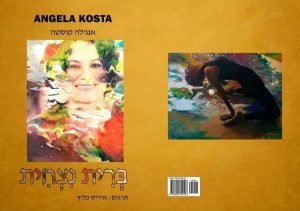
In this special interview that I initiated, we delve into Angela Kosta’s spiritual world and her inspiring work in advancing universal poetry, alongside our joint project, Angela Kosta’s fascinating poetry book, Eternal Pact (“בְּרִית נִצְחִית”), which I had the privilege of translating and editing into poetic Hebrew and which has received praise and literary reviews in Israel.
Among them is the profound article by writer, poet, literary critic, and publicist Herzl Hakak, former Chairman of the Hebrew Writers Association, “Angelic Poetry: The Eternal Pact, Between Hope and Crises,” in which he illuminated the spiritual and poetic power of Angela’s work and its journey into the mysteries of the soul.
Also among them is the profound and moving article “On Eternal Pact” by writer, poet, and literary critic Yehudit Malik-Shiran, founder and director of Bat Or Publishing House and owner of Radio Epilog, published in Al HaDerech (“On the Road”), in which she illuminated the poetic and spiritual world of the work with great sensitivity, depth, and beauty.
My heartfelt thanks to Naama Mashiach Cohen for hosting this initiative and for providing such a distinguished platform in MOKASUNI magazine for this artistic connection, which forms a bridge of peace through love, humanity, and infinite light between souls.
Iris Calif: I am excited and proud to welcome today, for a special interview in MOKASUNI, the unique international magazine for culture, art, literature, lifestyle, and universal poetry, Angela Kosta, an extraordinary poetic and human voice of international renown.
Iris Calif: I am deeply excited and proud to welcome today, for a special international literary interview, Angela Kosta, an extraordinary poetic and human voice of international renown.
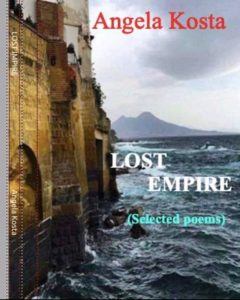
Angela Kosta, born in Albania and living in Italy, is an award-winning, legendary and multifaceted woman, a poet, author, translator, literary critic, journalist, editor-in-chief, and publisher of leading international literary magazines.
Her extensive body of work has crossed borders, been translated into 45 languages and published in hundreds of journals around the world. Throughout her remarkable literary and artistic journey, Angela has received extensive international recognition, including prestigious cultural awards at the Senate of the Italian Republic and honorary doctorate degrees.
Through her tireless and meaningful work, she serves as a true ambassador of culture and peace, building literary bridges and promoting poets and creators from across the globe.
- Journey, Identity, and the Connection Between Worlds
Iris: Dear Angela, you contribute profoundly and uniquely through your spiritual world and poems to universal poetry, and to the advancement of literature and art globally. It is an immense privilege to speak with you. Could you tell me about yourself, your journey, and the special connection between all of these worlds?
Angela Kosta: My journey has been shaped by words, but also by people, places, memories, encounters and the constant search for meaning. I was born in Albania and have lived in Italy for many years. Moving between cultures has profoundly influenced my identity as a writer, poet, translator, journalist, editor and publisher.
I have always considered literature not as an isolated territory, but as a meeting place. Poetry, journalism, translation, criticism and cultural promotion may have different languages and methods, yet they are connected by the same responsibility: to listen, to understand and to give voice.
My Albanian roots and my life in Italy have taught me that belonging can have more than one dimension. I do not see cultures as closed spaces. I see them as open windows through which people can encounter one another.
This is why I have dedicated much of my work to creating literary and cultural bridges. Writing allows me to explore the inner world; translation allows me to enter another person’s world; journalism allows me to document and share; editing and publishing allow me to create spaces where other voices can be heard.
For me, all these paths ultimately lead to the same place: the human being.
- Balancing Creation and Management
Iris: As a creator who is also an editor and a magazine owner, how do you manage to balance the heart and imagination required for writing poetry with the critical and organizational eye needed to manage a literary platform?
Angela Kosta: I do not consider these two dimensions opposites. The poet listens with the heart, while the editor learns to listen with responsibility.
When I write, I need freedom, intuition and silence. When I edit, I need distance, precision and critical attention. The difficulty is knowing when to move from one dimension to the other.
Managing literary magazines and cultural projects requires discipline: deadlines, texts, translations, correspondence, selection and countless organizational details. But I try never to allow the administrative side to extinguish the emotional reason why I began.
Every publication should preserve something alive.
I also believe that an editor must respect the identity of every author. Editing should not erase a voice in order to impose another voice. It should help the work reveal its strongest and most authentic form.
- Poetry as an International Bridge
Iris: In a world full of political and geographical divisions, how do you believe universal poetry and translation are capable of crossing borders, connecting different souls and cultures, and serving as a bridge of peace and humanity?
Angela Kosta: Poetry can cross borders that politics often cannot.
A poem does not ask the reader which country they belong to, what language they speak, or what their political position is. It speaks first to the human dimension. Pain, love, exile, memory, loneliness, hope, motherhood, loss and the desire for peace belong to everyone.
Translation makes this encounter even more powerful. When a poem enters another language, it does not simply change words; it carries an experience from one culture into another.
I have always regarded translation as an act of cultural generosity. It tells us: your voice deserves to be heard beyond the place where you were born.
This is why I believe literature can contribute to peace, not through slogans, but through understanding. When we truly encounter another person’s inner world, it becomes more difficult to consider that person a stranger.
- The Role of the Editor and Critic
Iris: As a literary editor and critic, what are the most important criteria for you when choosing a piece of work for publication or giving a platform to a new creator from around the world?
Angela Kosta: The first criterion is authenticity. I want to feel that the author has something genuinely personal to say.
Technique is important, but technique alone cannot create literature. I look for a distinctive voice, emotional truth, imagery, depth of thought and the ability to create an authentic relationship with the reader.
I also consider the internal coherence of a work. A poem does not necessarily need to be perfect, but it needs to possess a reason for existing.
When I encounter an emerging creator, I do not ask only whether the work is already accomplished. I also ask whether there is a voice developing there.
An editor should be able to recognize potential without compromising literary quality. Giving someone a platform is not merely an act of visibility; it is also an act of responsibility.
- The Meaning of the Word in the Technological Age
Iris: We live in a rapidly changing digital and technological era. How does your magazine deal with these challenges, and how do you preserve the pure and spiritual essence of poetic creation?
Angela Kosta: Technology has changed the way literature travels, but it has not changed the essence of why we write.
Digital platforms allow a poem written in one country to reach readers thousands of kilometres away within seconds. This is an extraordinary opportunity. At the same time, speed can sometimes encourage superficiality.
The responsibility of an editor today is therefore greater, not smaller. We must use technology without allowing technology to dictate the value of a work.
A poem still needs silence. It still needs time. It still needs an attentive reader.
I welcome digital innovation when it serves literature, but I believe the human voice must remain at the centre. Technology can distribute a poem; it cannot replace the soul that created it.
- Mission and Promotion of Creators
Iris: What motivates you to dedicate your efforts, beyond your personal creation, to promoting other poets and creators from around the world? What is the greatest sense of satisfaction in this mission?
Angela Kosta: Perhaps one of the deepest reasons is that I know how important it is for a creator to be seen and heard.
Literary life should not become a competition in which only the most visible names receive attention. There are extraordinary writers and poets in many countries whose voices deserve international recognition.
Promoting other creators gives meaning to my work beyond my own books. Through magazines, anthologies, translations and cultural projects, I try to create opportunities for encounters.
The greatest satisfaction comes when I see a poet who was previously unknown to a wider audience finding new readers, new translations or new cultural connections.
If my work can open one door for another person, that is already a meaningful achievement.
- Sources of Inspiration and Spirit
Iris: From what spiritual or internal fountain do you draw inspiration for your writing, and how is the spiritual dimension of life reflected in your literary and artistic choices?
Angela Kosta: My deepest source of inspiration is the inner human landscape.
I am inspired by memory, silence, love, suffering, absence, nature, the passage of time and the extraordinary mystery of existence. Some experiences remain within us for years before they become words.
Spirituality, for me, is not necessarily connected to a single definition or formula. It is the awareness that human life contains dimensions that cannot always be explained rationally.
In poetry, I search for that invisible space where pain can become understanding and where loss can sometimes become a form of inner transformation.
The spiritual dimension of my writing is therefore not something I add deliberately. It emerges naturally from the way I look at life.
- The Connection Between Journalism and Poetry
Iris: For creators who combine the world of journalistic writing with the world of poetry, how do these two different forms of expression feed each other and merge into one complete creation? For you, Angela, as someone who is both a poet and a journalist, how do documentation and journalism meet the emotion, metaphor, and depth of universal poetry?
Angela Kosta: Journalism and poetry begin from different responsibilities, but they can meet in the same human space.
Journalism asks me to observe, verify, document and communicate. Poetry asks me to enter beneath the surface, to listen to what is invisible and to transform experience into image and emotion.
As a journalist, I cannot replace facts with imagination. As a poet, however, I can explore the emotional truth that often exists behind those facts.
An event may last a few hours, but the human consequences of that event may remain for years. Journalism records the moment; poetry can sometimes reveal its echo.
This is why I consider both disciplines valuable.
One teaches me to look carefully at the world; the other teaches me to look deeply into it.
- The Evolution of Personal Poetry
Iris: Looking back on your personal poetic and literary journey, from the beginning of your career until today, how has your poetic voice evolved, and what new creative worlds do you aspire to explore in the future?
Angela: Over the years, my poetry has changed alongside me. In the early stages, it was more closely connected to immediate emotions, memory, pain, and personal experiences. With time, however, my voice began to seek greater depth, transforming individual experience into a broader reflection on existence, identity, love, loss, rebirth, and the relationship between human beings and the world.
Today, I feel that my poetry is more conscious and freer. I no longer seek merely to express what I feel, but to give poetic form to what often cannot easily be put into words: invisible wounds, waiting, absence, loneliness, hope, and the inner strength that enables us to begin again. For me, poetry has increasingly become a meeting place between experience and imagination, between memory and the future, between the personal and the universal.
I do not yet know exactly which worlds I will explore next, but I want to continue delving into the human soul, with all its contradictions and infinite possibilities. I would like to move towards a poetry that is even more essential and, at the same time, more capable of engaging in dialogue with other cultures, languages, and artistic forms. Above all, I am interested in continuing to build bridges: between people, countries, generations, and different sensibilities.
I believe that the true evolution of a poet does not lie in searching for a completely new voice, but in taking the voice one already possesses ever deeper, allowing it to mature through life. And I will continue to write for precisely this reason: to understand myself more deeply, but also to encounter, through words, the humanity of others.
- Dealing with Criticism
Iris: As someone who knows the world of literature from all angles, as a writer, editor, and critic, how do you perceive the role of literary criticism today? Is it meant to build, guide, or reflect?
Angela Kosta: Literary criticism should first of all help us read more deeply.
I believe criticism can build, guide and reflect, but it must always be grounded in intellectual honesty. Praise without analysis is not criticism, and criticism without respect can become destruction.
A serious critic should be able to recognize both the strengths and the weaknesses of a work without humiliating the author.
For emerging writers especially, constructive criticism can be invaluable. It can reveal possibilities that the author has not yet recognized.
The critic should not stand above literature as a judge. The critic should stand beside the work as a thoughtful reader who helps illuminate it.
- Hobbies and Parallel Worlds
Iris: Beyond the intensive engagement with words, poetry, and editing, what are your secret hobbies and passions in your spare time? Where do you find quiet and recharge outside the literary world?
Angela Kosta: I find my quietest moments in simple things.
I love silence, nature, music and moments in which I can step away from the constant movement of cultural and literary life. I also enjoy observing people and everyday life without necessarily thinking about turning everything into a text.
There are moments when I simply want to be present, to drink a coffee, listen to music, walk, look at the sky or spend time with the people I love.
Perhaps my greatest “secret hobby” is observation. Even when I am not writing, I am collecting impressions, gestures, colours and emotions. A writer never completely stops observing.
- Moments of Everyday Inspiration
Iris: If you had to describe a perfect day in your life, what would it look like? What small and simple things in daily life, such as family, music, a cup of coffee, an encounter, nature, give you the greatest happiness?
Angela Kosta: A perfect day does not need to be extraordinary.
For me, it would begin peacefully, without haste. A good coffee, a little silence, sunlight through a window and the feeling that I have time to breathe.
I find happiness in conversations with people I care about, in an unexpected message, in music, in nature and in those small moments when life reminds us that we do not need much to feel grateful.
I also love the moment when a sentence suddenly appears in my mind and I know that it must be written down.
Perhaps this is one of the greatest gifts of being a writer: discovering that an apparently ordinary moment can contain an entire universe.
- A Literary and Spiritual Connection: Eternal Pact
Iris: I had the immense privilege and great joy of translating and editing into literary, poetic, and spiritual Hebrew your legendary, valuable, and fascinating book of poems, Eternal Pact (“בְּרִית נִצְחִית”), which was published by Amazon in 2025.
It is a book that invites the reader to enter magical and captivating spiritual worlds of happiness and love, alongside pain and heartbreak. This wondrous creation moves between an eternal pact of light and love that triumphs over pain, and a deep, touching human longing filled with yearning for your homeland, expressing the beauty of roots and humanity.
The book was highly praised in enthusiastic literary reviews by two of the most prominent and esteemed literary critics in Israel: Herzl Hakak, who defined your work in his articles published in the esteemed Israeli online magazines News1, MOKASUNI, and Bkiovnhroh (“In the Direction of the Wind”) as “angelic poetry” and a wondrous journey to uncover the mysteries of the soul; and Yehudit Malik-Shiran, who wrote a unique article titled “On Eternal Pact,” published in the renowned online journal Al HaDerech (“On the Road”).
Please tell me, Angela, about the book and the beautiful, moving poems presented there, and what is the spiritual vision and deep message that this book wishes to illuminate in the heart of the world?
Angela Kosta: Eternal Pact is a very intimate book for me. It was born from a dialogue between light and darkness, memory and present, love and loss, homeland and distance.
The title itself expresses an idea that is central to my poetic vision: some bonds cannot be destroyed by time or geographical distance. There are relationships, memories and spiritual connections that remain within us even when life changes everything around them.
The poems move through different emotional territories, love, longing, pain, hope, roots and the search for inner light. My homeland is also present, not simply as a geographical place, but as a profound part of memory and identity.
I believe that every human being carries an inner homeland. It can be a person, a childhood, a landscape, a language, a lost embrace or a place that continues to live within us.
The spiritual message of the book is ultimately one of transformation. Pain does not disappear simply because we wish it away. But through awareness, love and memory, pain can acquire another meaning.
The eternal pact I speak of is therefore a pact with life itself: the decision to continue loving, remembering, creating and believing in light even after experiencing darkness.
I am deeply grateful to you, Iris, for bringing these poems into literary Hebrew. Translation is an extraordinary act of trust, and knowing that these poems can enter the heart of Hebrew-speaking readers gives the book a new life.
- Vision and Message for the Future Generation
Iris: What is your greatest vision for the future of literature and universal poetry, and what message would you like to leave for young poets who are just starting their journey and looking for their voice in the world?
Angela Kosta: My greatest hope is that literature will continue to defend what is deeply human.
I would like the poetry of the future to remain courageous, free and capable of crossing borders without losing its identity. I hope young writers will use technology as an instrument, but never allow algorithms, trends or the desire for visibility to decide what they should write.
To young poets, I would say: do not search too hard for a voice. Search for the truth that only you can express. Your voice will emerge from that truth.
Read widely. Listen. Observe. Learn from others, but do not imitate them. Accept criticism without allowing it to destroy your confidence. And never be ashamed of your roots.
Most importantly, do not write only to be seen. Write because there is something within you that needs to become a word.
Literature does not need more noise. It needs authentic voices.
And if poetry can teach us anything, it is that a single sincere word, when it comes from the deepest part of the human being, can travel farther than any border.
Dearest Angela,
The editorial team of MOKASUNI magazine and I wish you, from the depths of our hearts, abundant success, blessings and light, the fulfillment of your dreams, and continued fruitful and inspiring creativity throughout your unique literary and artistic journey.
We thank you wholeheartedly for sharing with us your rich, spiritual and fascinating world, and for your meaningful work and unique contribution to the advancement of literature, art and universal poetry, to building bridges of culture and peace between people and nations, and to giving a platform and a voice to creators from around the world.
We wish you continued success in sowing light through your words and your art, inspiring readers and creators throughout the world, and connecting cultures, spiritual worlds and souls through literature.
IRIS CALIF- ISRAEL
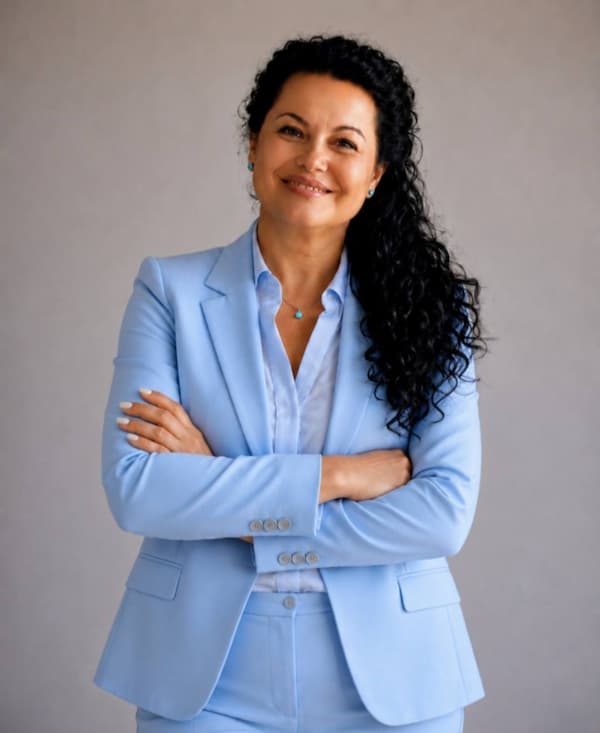
Iris Calif is an internationally award-winning poet and author, literary editor and translator. She is a poetry editor and translator for Bkiovnhroh (“The Direction of the Wind”), a magazine of literature, culture and art, where she is responsible for international relations and the editing of international poetry anthologies. She also edits and translates world poetry for MOKASINI and for the “World Poetry” section of the literary website Hadarim. She serves as Head of the Israeli Liaison Department of CHINH Magazine of Arts and Literature (Hong Kong–China), is a member of the international SAPS Association for Artists and Writers, and a member of the editorial board of the English edition of the World Poetry Yearbook.
Among the international awards and honors she has received:
The Grand Prize of Excellence, within the international award “Tra le parole e l’infinito” (Italy, 2026), as the only recipient from Israel; the Special Prize for Excellence, City of Galateo – Antonio De Ferraris (Italy, 2024), for her poem “Angel of Life”; Best International Poet of 2023, awarded by IPTRC–CHINH (China); the winning entry representing Israel in the Friedrich Schiller International Literary Competition (Germany, 2025), for her poem “The Desert Bride”; and the international literary award “The Greatest Poets of the World” (Greece–Mexico, 2026).
She is the recipient of an Honorary Doctorate awarded by the International Forum for Creativity, Humanity and Coexistence in the Kingdom of Morocco. In 2024, she was selected as one of the 20 leading international journalists by Legacy Crown’s – Crown of Heritage (Asia). She has also received certificates of recognition from the Professional Writers’ Union of Russia and the international magazine Arina NN, honoring her contribution to world culture, the international poetry community and friendship among peoples.
In further recognition of her literary achievements and international contribution, Calif joined the international literary association Creative Tribune – Germany (ILACT) and was appointed ILACT Ambassador and Representative in Israel. She is recognized as the first Israeli poet to receive this distinction, reflecting the organization’s recognition of her literary talent, creative work and contribution to the advancement of literature, culture and international literary relations.
Her poetry has been published and featured on radio and television, in literary journals, newspapers, anthologies and numerous literary platforms in Israel and around the world. Her work has been translated into many languages, including Spanish, Italian, Chinese, Arabic, Russian, Bengali, Turkish, Nepali, Assamese and Albanian. Articles and literary reviews of her work have been published by international literary critics and scholars, highlighting the distinctive character of her writing and its artistic and spiritual depth.
To date, she has published three books: “Bishvil Kasum Noshevet Lolita” (2001), “Yare’ach Bar” (2017), and “Bat Elohim” (“Daughter of God”) (2020). She is currently working on her fourth and fifth books.
Her work represents a distinctive Israeli voice on the international literary stage, seeking to enrich poetry with dimensions of love, harmony and humanity, while illuminating the human spirit, the sacred, and the profound connection between humanity, God and creation. Through her writing, translations and cultural endeavors, she carries with her a vision of universal peace
and an enduring dialogue among peoples, cultures and languages.

POEMS BY ANGELA KOSTA (ALBANIA – ITALY)
LIFE / Angela Kosta
Absent crumbs of happiness
abandoned on the dust of continuous disappointments,
Breathless I run through the clouds
in tears
among the deaf music of a lying sky,
kissed by an anxious, desperate wind, mingling with the surviving people quenched by torrential rains
of a desert that has disappeared in the mirage
of the unfortunate curtain.
Floating in the ocean of life,
I drown
and touching with your fingertips
The sunset of my own existence
I start walking again…
Run…
I’m still dying…
I am born again
Embracing the sun of hope.
LYING SWAN /Angela Kosta
Waves of Thoughts
In Search of Persuasion
Awkward by taciturn memories
Premise repeated every morning
Where from afar with deception
Your hand reached mine
While my happy heart smiled
Believing in the sweet breeze of love
In that magical infinity of the sea
Today in a storm equal to life
As well as my lacerated soul
Swan lying on the rocks
Where the roar of the waves throws it further
Elsewhere in a troubled world,
Haunted by a past that no longer exists
Maybe it never existed
Preterite in the trap of your eyes
Of your lips that emitted
Endless Words
Cheating candid, true feelings
Knowing the harm you were doing
Suppressing our oath
Everlasting Covenant
Today a spectre in oblivion.
SCULPTED SYMPHONY /Angela Kosta
This poem is dedicated to the tragedy of the 108 dead Albanians and 27 missing on the Otranto channel on Good Friday 28/03/1997. Only 37 were saved. I also dedicate this poem to all those who have not yet been able to save themselves with the hope that these tragedies will end as soon as possible.
In the open air
Unheard-of Symphony Began
with scary notes
Even the sea rebelled.
Dancing Waves
shamelessly, furiously
They brought to the shore
Whispers without moaning
of many little angels
barefoot
floating, soaked
With dull smiles
Like the little girl
Clinging to the young mother
with breasts of stone.
In the open air
The end of hope was heard
and in a foreign language
The sonnet of a ship
It was sculpted
on the mirror of the dark sea.
SNOW OF KISSES/Angela Kosta
Snow Solstice
I breathe with open arms.
Snow Kisses
dreaming of you everywhere
In the snow
I hear your voice in me
YOUR DIVINE SMILE
your divine smilein
in the sparkle of the stars
I will recognize
Mother
while the universe of nostalgia
will embrace my
soul.
הוספת תגובה